Mcrouter: a memcached protocol router

Mcrouter is an Open Source tool developed by Facebook for scaling up the memcached deployments:

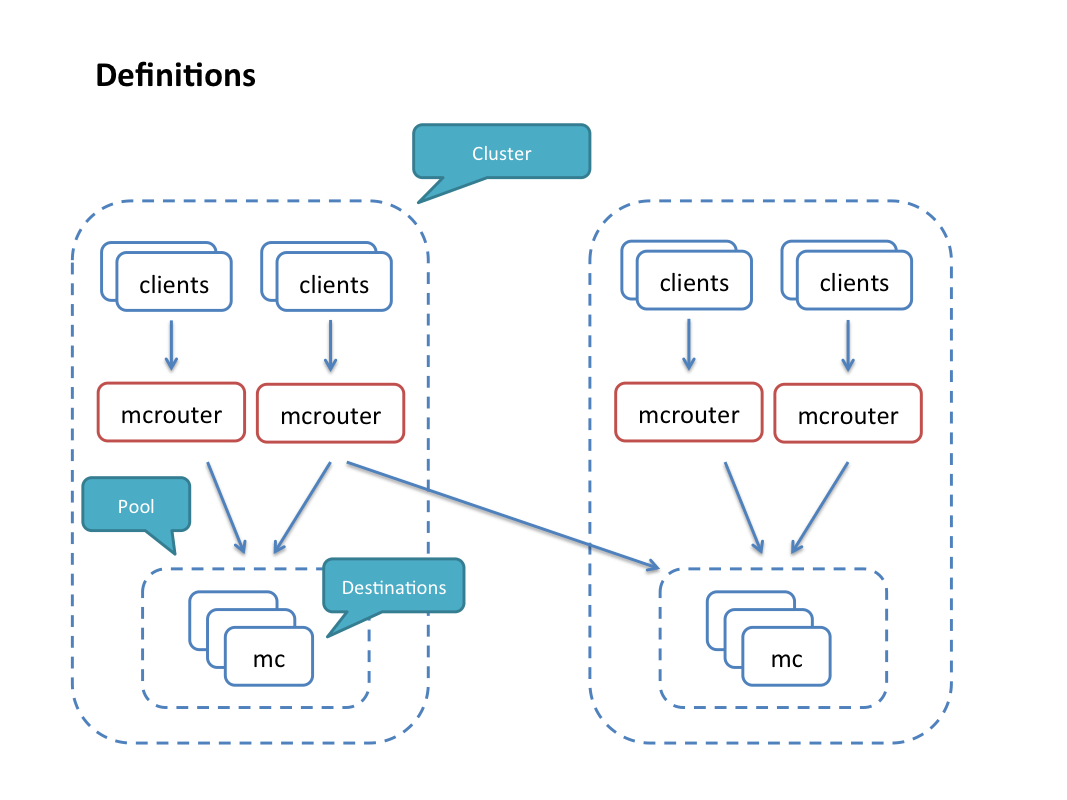
Mcrouter is a memcached protocol router for scaling memcached (http://memcached.org/) deployments. It’s a core component of cache infrastructure at Facebook and Instagram where mcrouter handles almost 5 billion requests per second at peak.

Here is a good overview of some of the scenarios where Mcrouter is useful.  There’s more than one.  Here are some of the features to get you started:

  • Memcached ASCII protocol
  • Connection pooling
  • Multiple hashing schemes
  • Prefix routing
  • Replicated pools
  • Production traffic shadowing
  • Online reconfiguration
  • Flexible routing
  • Destination health monitoring/automatic failover
  • Cold cache warm up
  • Broadcast operations
  • Reliable delete stream
  • Multi-cluster support
  • Rich stats and debug commands
  • Quality of service
  • Large values
  • Multi-level caches
  • IPv6 support
  • SSL support

Amazon AWS : MTU for EC2

I came across this handy Amazon AWS manual for the maximum transfer unit (MTU) configuration for EC2 instances.  This is not something one needs every day, but, I’m sure, when I need it, I’ll otherwise be spending hours trying to find it.

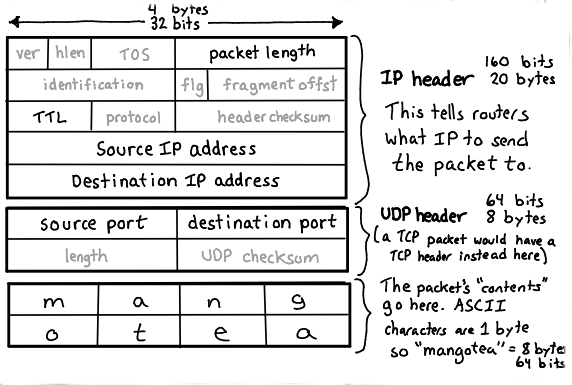
The maximum transmission unit (MTU) of a network connection is the size, in bytes, of the largest permissible packet that can be passed over the connection. The larger the MTU of a connection, the more data that can be passed in a single packet. Ethernet packets consist of the frame, or the actual data you are sending, and the network overhead information that surrounds it.

Ethernet frames can come in different formats, and the most common format is the standard Ethernet v2 frame format. It supports 1500 MTU, which is the largest Ethernet packet size supported over most of the Internet. The maximum supported MTU for an instance depends on its instance type. All Amazon EC2 instance types support 1500 MTU, and many current instance sizes support 9001 MTU, or jumbo frames.

The document goes into the detail of how to set, check and troubleshoot MTU on the EC2 instances, which instance types support jumbo frames,  when you should and shouldn’t change the MTU, etc.

The following instances support jumbo frames:

  • Compute optimized: C3, C4, CC2
  • General purpose: M3, M4, T2
  • Accelerated computing: CG1, G2, P2
  • Memory optimized: CR1, R3, R4, X1
  • Storage optimized: D2, HI1, HS1, I2

As always, Julia Evans has got you covered on the basics of networking and the MTU.

Use vimdiff as git mergetool

Ruslan Osipov has a very handy tutorial on how to setup Vim text editor as git merge tool, for resolving git conflicts.

Basically, run the following commands to tell git to use Vim as a merge tool (don’t forget the –global flag if you want it for all your projects, not just the current one):

git config merge.tool vimdiff
git config merge.conflictstyle diff3
git config mergetool.prompt false

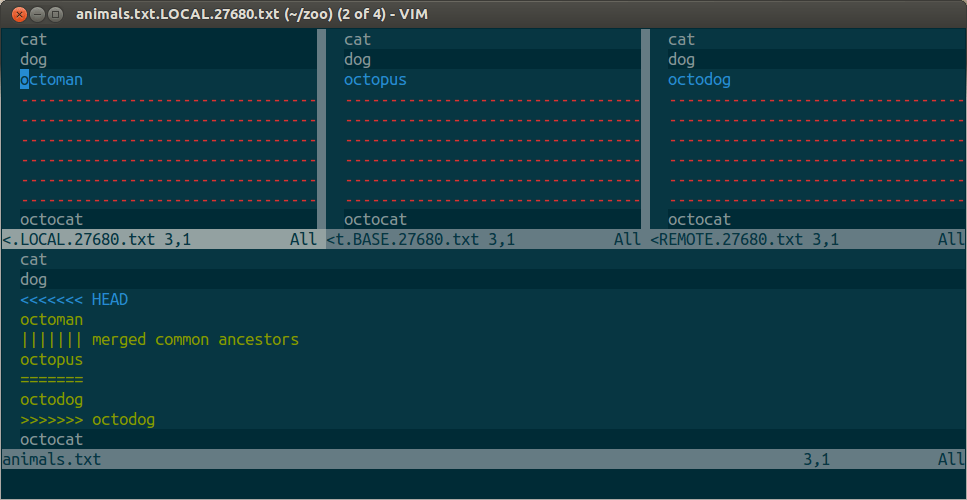
With that, running “git mergetool” after a conflict was reported, will result in something like this:

The three way split window will show local version (–ours) on the left, the remote version (–theirs) on the right, and the base version with the conflict in the middle.  You can then get changes from one window into another using the following Vim diffget commands:

:diffg RE  " get from REMOTE
:diffg BA  " get from BASE
:diffg LO  " get from LOCAL

Awesomeness!

Check a few of Ruslan’s other vim-related articles.

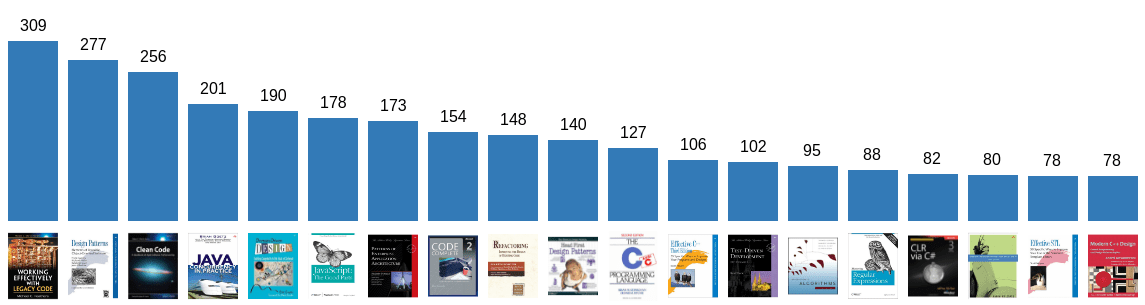
The Most Mentioned Books On StackOverflow

Slashdot links to “The Most Mentioned Books On StackOverflow“.

How we did it:

  • We got database dump of all user-contributed content on the Stack Exchange network (can be downloaded here)
  • Extracted questions and answers made on stackoverflow
  • Found all amazon.com links and counted it
  • Created tag-based search for your convenience
  • Brought it to you

I’ve previously linked to a similar selection of “Top 29 books on Amazon from Hacker News comments“.