
Replicant is a fully free Android distribution running on several devices, a free software mobile operating system putting the emphasis on freedom and privacy/security.
Found via a mention in the Slashdot interview with Richard Stallman.
All posts across the whole website belong to this category. They might also belong to some other categories as well, but this one holds all of them. Hence the descriptive name – All.
Replicant is a fully free Android distribution running on several devices, a free software mobile operating system putting the emphasis on freedom and privacy/security.
Found via a mention in the Slashdot interview with Richard Stallman.
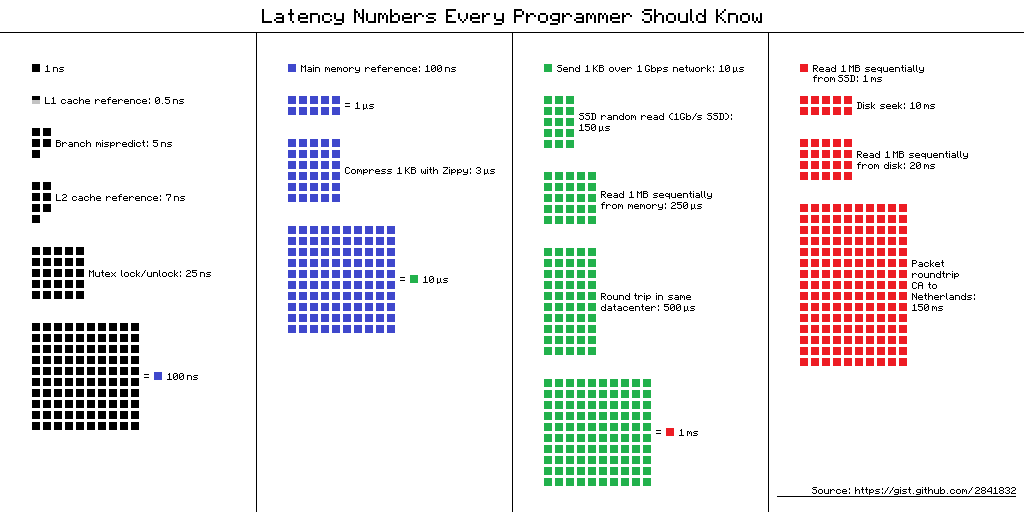
I’m saving this here for current and future generations of programmers:
Latency Comparison Numbers
--------------------------
L1 cache reference                            0.5 ns
Branch mispredict                             5   ns
L2 cache reference                            7   ns             14x L1 cache
Mutex lock/unlock                            25   ns
Main memory reference                       100   ns             20x L2 cache, 200x L1 cache
Compress 1K bytes with Zippy              3,000   ns
Send 1K bytes over 1 Gbps network        10,000   ns    0.01 ms
Read 4K randomly from SSD*              150,000   ns    0.15 ms
Read 1 MB sequentially from memory      250,000   ns    0.25 ms
Round trip within same datacenter       500,000   ns    0.5  ms
Read 1 MB sequentially from SSD*      1,000,000   ns    1    ms  4X memory
Disk seek                            10,000,000   ns   10    ms  20x datacenter roundtrip
Read 1 MB sequentially from disk     20,000,000   ns   20    ms  80x memory, 20X SSD
Send packet CA->Netherlands->CA     150,000,000   ns  150    ms

Notes
-----
1 ns = 10-9 seconds
1 ms = 10-3 seconds
* Assuming ~1GB/sec SSD

Credit
------
By Jeff Dean:               http://research.google.com/people/jeff/
Originally by Peter Norvig: http://norvig.com/21-days.html#answers

Contributions
-------------
Some updates from:                      https://gist.github.com/2843375
Great 'humanized' comparison version:   https://gist.github.com/2843375
Visual comparison chart:                http://i.imgur.com/k0t1e.png
Nice animated presentation of the data: http://prezi.com/pdkvgys-r0y6/latency-numbers-for-programmers-web-development/
This is a copy-paste of this gist, referenced from this blog post. Read and share both, for the better world.

Found in this set of historical photographs.
I came across a collection of free data science books:
Pulled from the web, here is a great collection of eBooks (most of which have a physical version that you can purchase on Amazon) written on the topics of Data Science, Business Analytics, Data Mining, Big Data, Machine Learning, Algorithms, Data Science Tools, and Programming Languages for Data Science.
Most notably, there are introductory books, handbooks, Hadoop guide, SQL books, social media data mining stuff, and d3 tips and tricks. There’s also plenty on artificial intelligence and machine learning, but that’s too far out for me.
Fixing Twitter – here’s a reasonable rant on what’s wrong with Twitter and how to fix it. Product managers and marketing people should definitely read.
Second–and this one is obvious to almost everyone–Twitter needs to focus on realtime events. When I open Twitter during a major debate in the US, or when a bomb has exploded in Bangkok, there should be a huge fиcking banner at the top that says “follow this breaking event.” It shouldn’t just search for a hashtag–it should use intelligent algorithms to show me all of the relevant content about that event. It should be the place you go to learn about what is happening in the world right now. When something major happens in the world/your country/your city, you should be trained to immediately and automatically think, “open Twitter to get updates.” This is so obvious to me that I wonder what Twitter’s product team has been doing—are they over-designing a solution to this? It’s so simple. 90% of the UI and 80% of the search functionality is already in the app.