This is one of the most convincing things that I’ve seen for the seat belt safety promotion. There should be more installations of these across the globe.
Category: All
All posts across the whole website belong to this category. They might also belong to some other categories as well, but this one holds all of them. Hence the descriptive name – All.
Billion dollar club

The Wall Street Journal compiles a list of venture-back private companies, valued at $1 billion or more. There’s a table with the list of 120+ companies and an interactive chart to navigate it.
Note: This chart only includes companies that are privately held, have raised money in the past four years and have at least one venture-capital firm as an investor. Excluded from this list are companies that were majority-controlled by an institutional investment firm at one point. Only valuations confirmed by VentureSource or The Journal are included, based on direct investments, not secondary deals.
js-sequence-diagrams
js-sequence-diagrams – turns text into UML sequence diagrams, like this one:

It supports a couple of styles – simple and hand-drawn. Handy!
Five Linux-Ready, Cost-Effective Server Control Panels
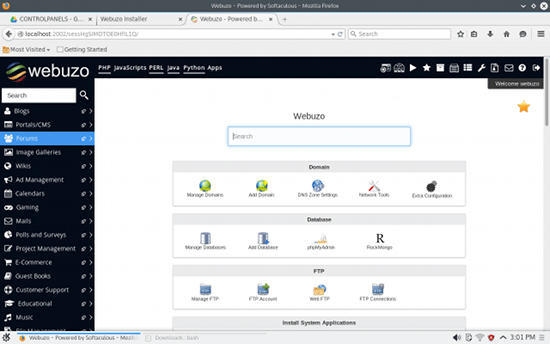
“Five Linux-Ready, Cost-Effective Server Control Panels” reviews 5 some alternatives to cPanel, which, they say, is rather expensive. My beef with cPanel is not the price, but the technical merit. Even though I love the fact that it is written in Perl, I don’t agree with its “let me handle everything” approach.
cPanel installs all the software that it helps to manage. This might be a “so what” issue for most people, but not for me. I like my servers clean. And I want to utilize the tools that already come with my server – RPM, yum/dnf, etc. Control panels can help with routine, but when something breaks, I should be able to go to the config files and deal with the problem using the distribution’s recommended ways. cPanel, unfortunately, breaks that. It downloads sources, applies patches, locally compiles things, and has its own layout for configuration files. That’s too much mess for me.
I haven’t used any of the other control panels reviewed in the article (I usually prefer the command line way), but I hope they aren’t as intrusive and abusive as cPanel. Sometimes control panels are useful for providing a bit of help to non-technical users (create mailbox, change email password, backup the website, etc), but if they are as needy as cPanel, thanks, but no thanks.
When monospace fonts aren’t: The Unicode character width nightmare
I don’t deal with Unicode and other character encoding on the daily basis, but when I do, I need every piece of information that has been written on the subject. Hence the link to this interesting issue :
As long as you stick to precomposed Unicode characters, and Western scripts, things are relatively straightforward. Whether it’s A or Å, S or Š – so long as there are no combining marks, you can count a single Unicode code point as one character width. So the following works:
	aeioucsz
	áéíóúčšž
Nice and neat, right?
Unfortunately, problems appear with Asian characters. When displayed in monospace, many Asian characters occupy two character widths.