The IT Crowd – geek comedy show

I am starting to fall for television. First there was (and still is, by the way) Comedy Central‘s The Daily Show. And now this – The IT Crowd, new comedy show on Channel 4… Boy, am I waiting for those times when my TV will be able to connect to souces like this, no matter where I live. I’m willing to pay for this today. In three years I’ll be desperate.

Anyway, I managed to see one of the episodes, thanks to a certain someone. It’s hilarious. It’s as funny as I could imagine, and even a bit more so. By the way, all episodes are online, it’s just they are for UK audience only. If you know how to become a UK audience – there’s all you need.

And let me tell you something – don’t let the name of the show stop you from watching it. There’s not that much of IT in it anyway. At least not in the episode that I’ve watched. It’s more of an office humor. If you’ve spent more than half an hour in any corporate or startup office recently – you’ll dig all the humor in the show.
Conspiracy of context sensitive advertising

I think I’ve uncovered another conspiracy by Google, particularly with their context sensitive advertising service AdSense. It’s not a bad conspiracy – as far as I am concerned, they are trying to do a good thing. But still, it’s a mean way to go about it.

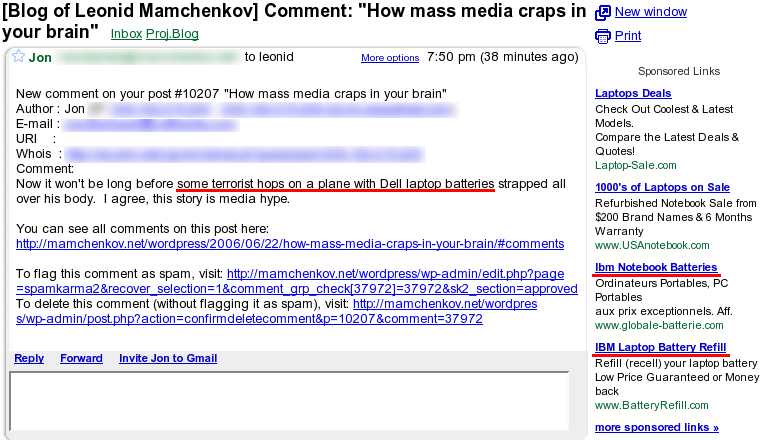
A reader of this blog left a comment to one of my earlier posts about media brain wash, a story about Dell notebook exploding at some conference. Jon agreed with me that this story was a pure media hype. In his comment he said exactly this:

Now it won’t be long before some terrorist hops on a plane with Dell laptop batteries strapped all over his body. I agree, this story is media hype.

In order for me not to miss any comments, and to respond faster to my readers, the moment any of your post a comment, I get an email notification. As you know, recently I moved all my email affairs to Google’s mail service GMail. Now, Google uses its own AdSense service to show ads to people while they are reading their emails. The content of the email is used to determine which related ads should be shown.

GMail adsense When I openned a notification email with Jon’s comment I was shown four ads on the right. All four ad links were about notebooks. Two links were generic, but two others featured a brand. And although the brand in the content of the email was Dell, both branded ads were about IBM.

Now, you might think that this is just a coinsidence. But for two links out of four? I don’t think so. What is more probable is that Google undestood that Dell brand was used in connection with terrorism and tried to substitute that for IBM. Probably that was an attempt to sell non-explosive items to terrorists. Thanks Google, but no thanks.

NOTE (this note should have been written a very small font, but since noone will read so far down, I’ll leave it as it is): please, don’t take this entry seriously. I’m just messing with you.

GMail migration – done

I have finished my migration to GMail process. I have all my email archives uploaded, marked as read, and most of the messages labeled. Of course, as with any migration, there were some rough edges and few messages just didn’t make it through, while a few others were dumped into archives without being properly categorized. But overall I am happy. Those few messages that didn’t get through were probably useless anyway. And categorization is not vital anymore with Google search engine behind the inbox.

GMail usage for 15/08/2006

‘All Mail’ suggests that I have slightly more than 20,000 discussions. In terms of space usage, I am at 42%1156 MB used out of 2754 MB. That’s not too bad. My current new mail rate is not that high, and GMail is constantly increasing the size of the mailbox. I think it’ll be enough. If nothing else, I know how have a lot of stuff that I can delete to clean up some space. Some of the messages date as far back as 1999 – surely there’s something that I won’t even miss.

Technology related reading – Steve Yegge

I’ve been pointed to the (now abandoned) blog of Steve Yegge way too many times. But for some reason I never read it. Maybe it’s the look of it. Maybe it’s because of the lengthy articles. But that’s a fact – I haven’t read a single post there until today, desipte the URLs being saved in those many places where I look for stuff to read.

Steve Yegge worked for several years (7?) at Amazon.com and last time I heard is still there, being a development manager for internal Amazon stuff. You can read more about him here, if you wish. By the way, he has also started a real blog too.

Anyway, today I discovered his excellent writings. It’ll take me some time to go over all of them, but here are the few really good ones from those that I’ve read today.

  • The Nonesuch Beast – rant about some irreducibly complex problem domains that people think are “simple”.
  • Practical Magic – thoughts about what a programmer is allowed to get away with not knowing.
  • Saving Time – rambling montage on productivity, emacs extensions, and automation habits. MUST READ.
  • The Five Essential Phone-Screen Questions – an exposition on how he personally conducts the first 10 minutes of a technical phone screen.
  • It’s Not Software – an essay about differences between traditional software development and creating software services. This one is an absolute MUST READ.

There’s more, of course.