What is Yahoo?

I came across a somewhat old question by TechCrunch’s Michael Arrington: What is Yahoo?

For me personally, Yahoo is, first of all, the company that bought most of the web services that I was using – Flickr, Delicious, and Upcoming back in the days when I was using it.  Secondly, Yahoo for me is a company no here, no there.  I appreciate how old they are and all.  But it never seemed to be serving any specific purpose.  It used to be a bookmark website, which I used for a bit, until it got overly complicated with categories, and SPAM.  Then it became a web mail and a search engine.  Then it an instant messaging provider.  Then a purchaser of some cool web applications.  Then a web developer resource.  And then I don’t know anymore.

It’s been a long while since I went to Yahoo.com and something tells me that I won’t be visiting it any time soon.  What about you?

Shorter URL? Longer URL? Funny URL?

This Slashdot discussion got me started.  The discussion is about URL shortening services and their impact on the Web.  Needless to say, most people who care about the Web, hate all kinds of third-party URL manipulations with a passion.   The reasons are numerous, and here are two that annoy me the most:

  • Obscurity.  You have no idea where you are going anymore.  It can be the newest scam website, an image, a huge video, or anything else for that matter.  When you see full URL, even if you don’t always can understand the full path, at least the domain name is a hint.
  • Latency. Most (all?) URL shortening services work via a redirect.  So whenever you click on the URL to visit a page, instead of going to the page directly you are going to the web service which expands that URL first, and then redirects you further.  This takes time and gives you nothing in return.

A lot of Slashdot people feel similar.  Yet it still makes for an interesting discussion.  Here are the bits that I picked up:

  • HugeUrl.com – web service that does the opposite of what URL shortening services do.  It takes any URL and makes it huge.  Just for the fun of it.
  • ShadyUrl.com – web service that obscures given URLs, making them look very suspicious. Also, for the fun of it.
  • There are a number of browser plugins that automate the expansion of short URLs, either on-demand or as you go.  Here is one for Firefox.  Here is one for Google Chrome.
  • Last year’s Coding Horror blog post discussing the problems of URL shortening services.

Also after a brief discussion and fooling around with my colleagues, I learned about Abcd-Whatever, which is a web service that lives on an extremely long domain name and offers free email addresses.  Such email addresses are hard for people to type correctly, impossible for some SPAM bots to grab, and excellent for testing web forms.

OhLife – private blogging via email

Over the years that I’ve been blogging, quite a few people asked me if I know of any easy way to maintain a private blog.  They seemed to not care about the rest of the world and just wanted a private diary, but without paper and without too much technical hassle.  Of course, there are many applications, like WordPress, that could be installed on a personal computer and used in private mode.  But that still seemed too much work for a diary.  So I never really had a good answer, except use any text editor and save files in some date-based directory structure.

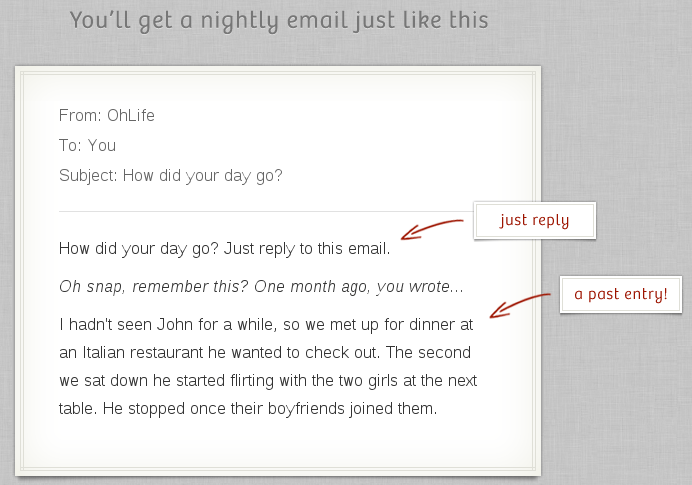
Recently I came across a very elegant solution to the problem though.  OhLife is a simple and straightforward blogging service.  It has two very distinct features that together set it apart from most other blogging services.  It enforces private blogs – only you see your entries.  No public stuff, no friends, no nothing.  And they help you build a habit out of blogging by sending you an email every night with a question “How did your day go?“.  This seems so natural and so simple that I can’t think of anybody who won’t be able to do it.

OhLife sample email

Twitter is not a social network

Just a couple of days ago I had a discussion with a friend of mine about Twitter.  He is not too much into social networks, but hearing all the time about Twitter, he decided to give it a shot again, and still felt that it was in no way suitable for him.  Normally, that would be enough for me to jump into my zealotical advocacy mode.  However this time I felt different.  I said that I’m not all that hot about Twitter anymore as I used to be.

You see, back in a day, Twitter had two things important to me, that it lost on the way to where it is now.  The first one was SMS gateway.  People could interact with Twitter via SMS.  This was important to me, because I could practically get anybody register at Twitter.  My grandparents know how to send SMS, using their pre-historic mobile phones.  Also, SMS coverage is way better, more reliable, and cheaper than any mobile Internet connection.  Unfortunately, Twitter limited its SMS gateway from global coverage to only a selection of countries (US, UK, etc), which don’t include the countries where I or my friends and family live.  A huge disappointment.

Secondly, back in a day, Twitter was about status updates.  That was partially enforced by the SMS user interface, where you just couldn’t assume that everyone has a browser nearby or even an Internet connection.  So the messages were more of the text and less of the links.  With SMS gateway going away, and with plenty of online marketing and PR people joining Twitter, this was also gone.  Now, most Twitter messages contain a link to an external resource.

I think that that also changed the culture of a place.  Before, 140 character limitation had a very good reason to be in place – that’s how many characters there are in an SMS message.  People were encouraged to formulate their updates within this limit.  Now that Twitter updates are mostly links, nobody cares about that limit.  Why would I want to limit myself to 140 characters, when I can use as much of them as I want and just tweet a link to my text?

So, if it’s not a social network with status updates anymore, what is it?  A news source?  But we had RSS for that, didn’t we?  Yes, we did, and we still do.  But RSS works differently.  RSS is more of a source-based system.  You pick your sources that you trust and want to follow – CNN, Slashdot, etc – and you subscribe to their RSS feed.  This will make sure that you get all published items, whether you are online or not.  If you’ve got a new interest or hobby – just find a few more sources of wisdom and subscribe to their RSS feeds.  Handling too much?  Just unsubscribe from some and you done.

Twitter is different.  It’s not so much as a source-based system, but an event-based system.  It doesn’t matter who you follow and what your interests are.  If something happens, you’ll know about it on Twitter.  A gadzillion people will tweet and re-tweet about it, and you will eventually catch it.  Or you can search for keywords that you have interest in, and then it will work very much like Google Alerts, letting you know about tweets that matched, no matter who or where posts them.

I am, personally, not a big news person.  I don’t care much about news.  What I care about are opinions and thoughts about news.  So for me personally, Twitter is not that interesting, because it only tells me what happens.  Slashdot and a collection of my other two hundred or so feeds tell me what happened and what people think about it.

For the last year or so, I only new that I am floating away from Twitter.  Yes, it’s there.  Yes, it’s getting more and more popular.  Yes, I’m pushing a bunch of links to it too – my blog posts announcements, some delicious bookmarks, an YouTube favorites.  Occasionally I even tweet a thought or a quote.  But I don’t read and follow it as much as I used to.  For the last couple of weeks or so, I was trying to figure out why, and now I think I have.

But until today that was only me and my thoughts.  Today however I got a confirmation of my thoughts being in the right direction.

Kevin Thau, Twitter’s VP for business and corporate development, announced during a presentation at Nokia World 2010 today that everyone’s favorite micro-blogging network is not actually a social network.

It’s not, you say?

No, says Thau: Twitter is for news. Twitter is for content. Twitter is for information.

ReadWriteWeb is one of many resources reporting from Nokia World 2000.
Urchin – Google Analytics in a box

Google Analytics has proven itself over and over again as an extremely valuable tool for pretty much everyone interested in website statistics.  But as awesome as it is, Google Analytics has a number of limitations.  These don’t come handy when you need to analyze non-public websites, such as intranets or web-based services behind closed firewalls.  Sure, there are plenty of alternatives to Google Analytics that you could go with.  But what if you wanted to stick to Google Analytics?  I thought you couldn’t (that is without tricks and ugly workarounds).  Apparently, I was wrong.  You could.

Urchin is a packaged Google Analytics application that you can run on your own servers, under your full control.  There are a few features in Urchin that are not in Google Analytics (mostly due to Google Analytics not having access to your server logs).  Here are the interesting ones:

  • Process historical logs
  • Status & error codes reports
  • Individual visitor history drilldown

These are things that you don’t probably care too much, if you only have a couple of personal blogs to manage.  But if you are a company with a few busy websites and large chunks of your revenues spent on the online advertising, you’d want each and every bit of information, including the above.

One other reason that probably only the enterprises will be interested in Urchin is the price.  While Google Analytics comes to everyone for free, you’ll have to pay USD $9,995 (yes, almost ten thousand!) for the Urchin license.

And even though the price is quite prohibitive and will leave most people still using Google Analytics, I think it’s nice to have this option.