After a year of using NodeJS in production

There are days, when I feel jealous of all the young kids playing around with new technologies.  I need a certain level of stability and acceptance of the technology before I can apply it to client projects.  And I need time, which is a very scarce resource lately.

And yet there are days, when I feel good about being somewhat reserved and conservative in my technology stack choices.  Reading this blog post makes me feel just that.  Of course I need to try it out for myself and shape my own opinion, but with my lack of time, this should do.

I spent a year trying to make Javascript and more specifically Node work for our team. Unfortunately during that time we spent more hours chasing docs, coming up with standards, arguing about libraries and debugging trivial code more than anything.

Would I recommend it for large-scale products? Absolutely not. Do people do that anyway? Of course they do. I tried to.

I would however recommend Javascript for front-end development such as Angular or React (like you have another choice).

I would also recommend Node for simple back-end servers mainly used for websockets or API relay.

Now if only somebody wrote a similar post about Docker …
Why Some People Get Promoted (And Others Don’t)

I enjoyed reading the article “Why Some People Get Promoted (And Others Don’t)“.  Unlike many other in this domain, it is simple, direct, and to the point.  TLDR version:

  1. Do great things.
  2. Tell people.

There are quite a few links to external resources, with research and insightful quotes.  Here are a couple of my favorite bits:

‘[S]ent does not mean received’ is a profound thing. Half of your job in this studio is doing your work, the other half of your job is communicating that it’s been done. Because if you do it, and I don’t hear about it, how do I know what’s going on? I’m not trying to control everything, but in an intimate work environment, where we’re really trying to develop something complex, a nod, saying, ‘I got it,’ helps move things along.

And this part, which resonates with my inner blogger:

Asking for help is part of getting better at your job.

3. Work where people can see you.

Gaining visibility might require going outside your office. Maybe you have a side project, or maybe your work culture isn’t a healthy environment to pursue visibility.

Promoting yourself doesn’t have to be on someone else’s terms. Write a book, start a blog, make a side-project, collaborate with new people outside of work, or speak at panels and conferences. Tell people about what you’ve done, what you’re doing, why it’s important, and how you did it. Give talks, teach others, raise your hand for new projects.

Wikiwand – Wikipedia Modernized

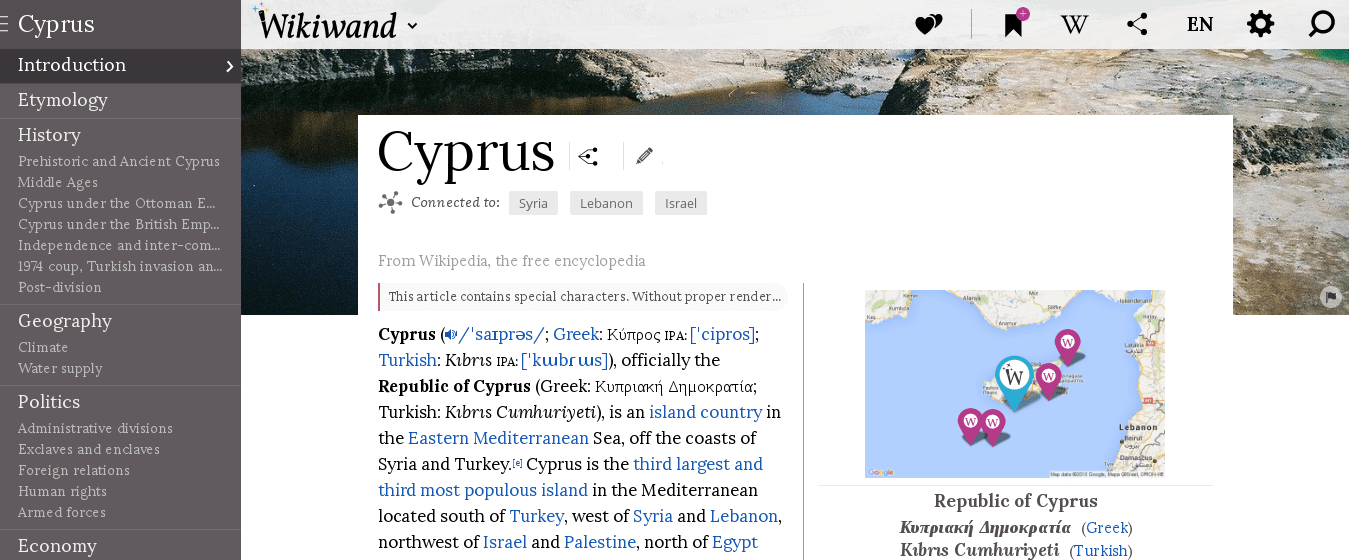
I came across an interesting take on WikipediaWikiwand.  It’s basically an upgraded and modernized design of the Wikipedia.  You can either search and browse it like you do with the regular Wikipedia, or, better even, install a browser extension (here’s one for Google Chrome), which will redirect all your Wikipedia page clicks through to Wikiwand.  You get exactly the same content, but now it’s actually quite pleasant to explore.  Have a look at Cyprus page, for example:

wikiwand

I’m not a frequent Wikipedia reader, but in the last couple of days, I have to say, I’ve found myself spending much more time than usual reading Wikipedia pages on the Wikiwand website.  Maybe, it is time for the Wikipedia face lift after all.

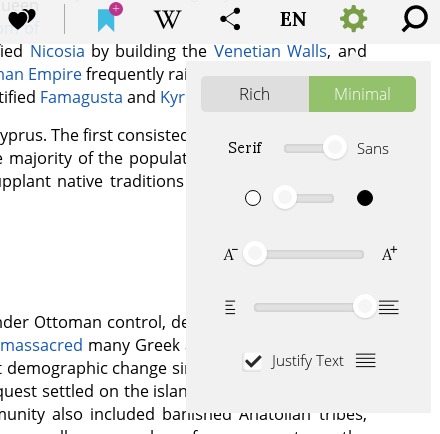
But it’s not just about forcing a different web design upon thee.  There’s more.  You get options (upper-right corner).  You can switch between light and dark designs, sans and serif fonts, adjust font size and text justification, and more. If you create account and login (Facebook is supported), you can bookmark pages too.

options

Even if you are not a fan of fancy websites, I suggest you give it a try for a couple of days.  You might find yourself quite surprised.

Rejected Princesses

Rejected Princesses is a series of illustrations of women whose stories wouldn’t make the cut for animated kids’ movies, illustrated in a contemporary animation style. Women too Awesome, Awful, or Offbeat for Kids’ Movies.

Lyudmila Pavlichenko

Love the website! All of it – the design, the content, the idea, the stories, the illustrations!  Found it by following the link to Lyudmila Pavlichenko story – the deadliest female sniper ever lived.

The Slashdot Interview With Larry Wall

Slashdot runs the interview with Larry Wall, the creator of Perl programming language.  There is a wide variety of questions.  Some are technical – about Perl 6, comparison to other programming languages (Python, PHP), Perl in the browser, etc.  Some are more generic – what kind of tools Larry uses, and what are his thoughts on English being lingua franca of the computer world.  The answers are often funny, yet very insightful.