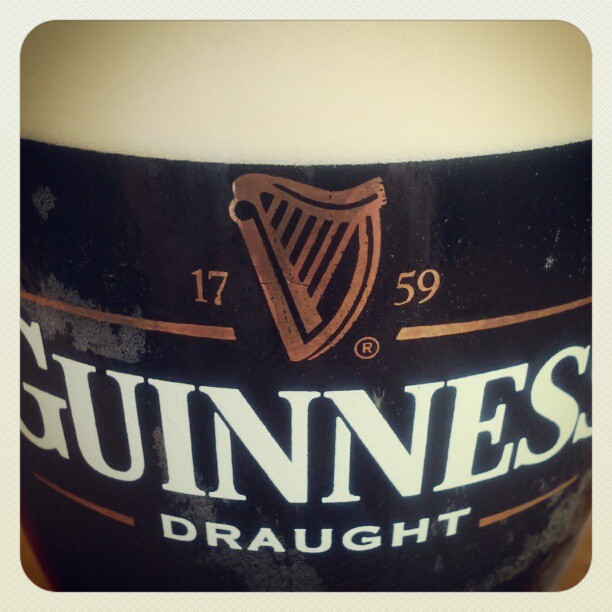
If you are a beer fan, you’ve probably heard about the famous Guinness bubbles problem. While bubbles in most other beers rise up, in Guinness they go down. A lot of people were puzzled by that fact, and now, it seems, the puzzle is solved.
According to the article in Technology Reviews, Irish mathematicians came up with an answer:
Today, a dedicated team of Irish mathematicians reveal the answer. Eugene Benilov, Cathal Cummins and William Lee at the University of Limerick say the final piece in this puzzle is the shape of the glass, which has a crucial influence over the circulatory patterns in the liquid.
To understand how, first remember that the motion of every bubble exerts a drag on the liquid around it. Now imagine what would happen if there were a region of liquid containing fewer bubbles near the wall of a pint glass and consequently a region of higher bubble density near the middle of the glass.
Benilov and co say that the drag will be higher in the region where the bubble density is higher, in other words near the centre of the glass. This creates an imbalance that sets up a circulation pattern in which the liquid flows upwards in the centre of the glass and downwards near the walls.
That’s exactly as observed in a pint of Guinness.
There are more details and image of an anti-pint in the article. Read it.
Also, while reading up on the subject, I’ve learned something else about Guinness – the widget.