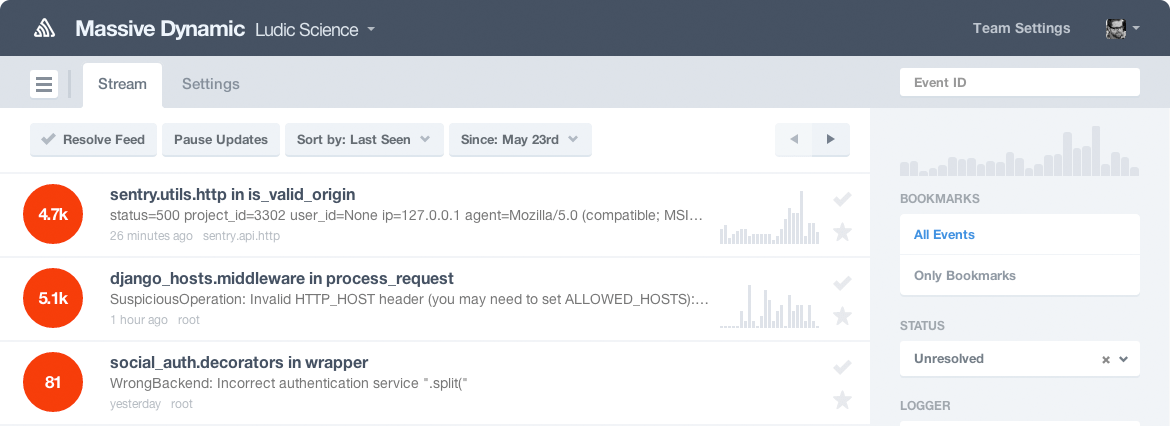
Sentry – an event logging platform focused on capturing and aggregating exceptions

Sentry – an event logging platform focused on capturing and aggregating exceptions.  Most of the code is Open Source (except for a few proprietary plugins), in case you want to run your own hosted version.

sentry

Supports Ruby, Python, JavaScript, Java, Rails, Django, PHP, iOS, node.js, .NET, and more.

PHP Fine Diff – PHP library to diff strings

PHP Fine Diff – PHP library to diff strings.  I’ve tried a few different implementations and all of them either required an external diff program couldn’t render HTML, or failed to due to enormous resource usage.  PHP Fine Diff does all I need and does it fast.   It’s also rediculously easy to use:

$fineDiff = new FineDiff($strOrig, $strNew);
$htmlDiff = $findDiff->renderDiffToHTML();

Found via this StackOverflow discussion.

WordPress 4.0 Beta 1 is now available!

WordPress 4.0 Beta 1 is now available!   Here are some of the changes:

  • Previews of embeds like YouTube and Vimeo.
  • Improved plugin installation experience.
  • Selecting a language during/for the installation process.
  • Improvements to the editor (somewhat needed after the recent upgrade of TinyMCE major version).
  • Separate panel for Widgets in the Customizer.

The Architecture of Open Source Applications

The Architecture of Open Source Applications

Architects look at thousands of buildings during their training, and study critiques of those buildings written by masters. In contrast, most software developers only ever get to know a handful of large programs well—usually programs they wrote themselves—and never study the great programs of history. As a result, they repeat one another’s mistakes rather than building on one another’s successes.

Our goal is to change that. In these two books, the authors of four dozen open source applications explain how their software is structured, and why. What are each program’s major components? How do they interact? And what did their builders learn during their development? In answering these questions, the contributors to these books provide unique insights into how they think.

If you are a junior developer, and want to learn how your more experienced colleagues think, these books are the place to start. If you are an intermediate or senior developer, and want to see how your peers have solved hard design problems, these books can help you too.

There is also the fourth book in the works – 500 lines or less.