Blog of Leonid Mamchenkov

You just stepped in a pile of posts.

Entries Tagged as 'testing'

On software testing

Posted in All, Programming, Technology on November 3rd, 2008 · No Comments

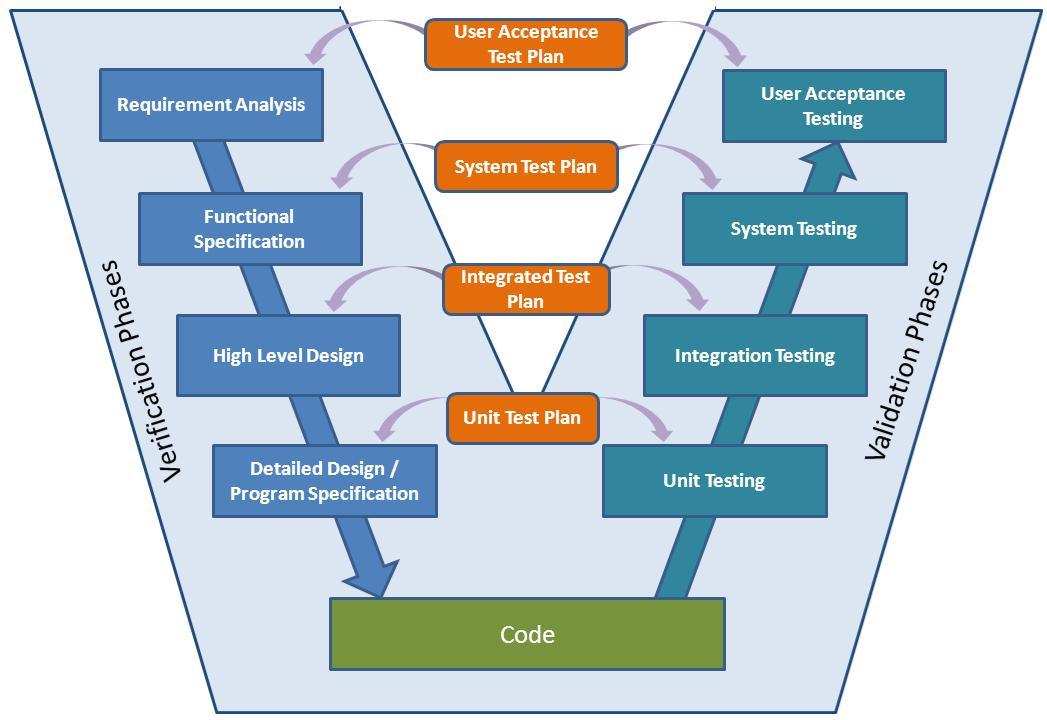
The software is checked very carefully in a bottom-up fashion. First, each new line of code is checked, then sections of code or modules with special functions are verified. The scope is increased step by step until the new changes are incorporated into a complete system and checked. This complete output is considered the final product, newly released. But completely independently there is an independent verification group, that takes an adversary attitude to the software development group, and tests and verifies the software as if it were a customer of the delivered product. There is additional verification in using the new programs in simulators, etc. A discovery of an error during verification testing is considered very serious, and its origin studied very carefully to avoid such mistakes in the future. Such unexpected errors have been found only about six times in all the programming and program changing (for new or altered payloads) that has been done. The principle that is followed is that all the verification is not an aspect of program safety, it is merely a test of that safety, in a non-catastrophic verification. Flight safety is to be judged solely on how well the programs do in the verification tests. A failure here generates considerable concern.

The above was written by R. P. Feynman, in Feynman’s Appendix to the Rogers Commission Report on the Space Shuttle Challenger Accident, 1986. More than 20 years ago. Much recommended reading.

Found via Richard Feynman, the Challenger Disaster, and Software Engineering.

→ No CommentsTags: , , , , ,

The Microsoft experience

Posted in All on November 8th, 2007 · 8 Comments

I smiled after reading this post.  It reminded me of the fact that in our office, designers use my laptop to test web sites on Microsoft Internet Explorer 6.  We have two guys doing the designs, and one of the uses Windows Vista, which runs MSIE 7.  Another one uses, I think, Windows XP, but with MSIE upgraded to version 7 too.    I heard it’s possible to have several versions of Internet Explorer running on the same Windows installation, but nobody around here knows how to do it or cares enough to experiment.

But the funniest thing in this whole story is that my laptop is running on Fedora Linux.

→ 8 CommentsTags: , , , , , , , , , , ,

Learning about Markov chain

Posted in All on November 1st, 2007 · 7 Comments

I’ve been hearing about “Markov chain” for long enough - it was time I learned something.  Wikipedia seemed like a good starting point.  I have to warn you though, be careful with scrolling on that page, because you can easily end up looking at something like this:

partial Markov chain

If you aren’t a rocket scientist or someone who solves integrals for fun, by all means, use the contents menu or jump directly to the Applications section.  That’s where all the fun is.  Here are some quotes for you to get interested and for me to remember.

Physics:

Markovian systems appear extensively in physics, particularly statistical mechanics, whenever probabilities are used to represent unknown or unmodelled details of the system, if it can be assumed that the dynamics are time-invariant, and that no relevant history need be considered which is not already included in the state description.

Testing:

Several theorists have proposed the idea of the Markov chain statistical test, a method of conjoining Markov chains to form a ‘Markov blanket’, arranging these chains in several recursive layers (’wafering’) and producing more efficient test sets — samples — as a replacement for exhaustive testing.

Queuing theory:

Claude Shannon’s famous 1948 paper A mathematical theory of communication, which at a single step created the field of information theory, opens by introducing the concept of entropy through Markov modeling of the English language. Such idealised models can capture many of the statistical regularities of systems. Even without describing the full structure of the system perfectly, such signal models can make possible very effective data compression through entropy coding techniques such as arithmetic coding. They also allow effective state estimation and pattern recognition

Internet applications:

The PageRank of a webpage as used by Google is defined by a Markov chain.

and

Markov models have also been used to analyze web navigation behavior of users. A user’s web link transition on a particular website can be modeled using first or second order Markov models and can be used to make predictions regarding future navigation and to personalize the web page for an individual user.

Statistical:

Markov chain methods have also become very important for generating sequences of random numbers to accurately reflect very complicated desired probability distributions - a process called Markov chain Monte Carlo or MCMC for short. In recent years this has revolutionised the practicability of Bayesian inference methods.

Gambling:

Markov chains can be used to model many games of chance. The children’s games Snakes and Ladders, Candy Land, and “Hi Ho! Cherry-O”, for example, are represented exactly by Markov chains. At each turn, the player starts in a given state (on a given square) and from there has fixed odds of moving to certain other states (squares).

Music:

Markov chains are employed in algorithmic music composition, particularly in software programs such as CSound or Max. In a first-order chain, the states of the system become note or pitch values, and a probability vector for each note is constructed, completing a transition probability matrix

Markov parody generators:

Markov processes can also be used to generate superficially “real-looking” text given a sample document: they are used in a variety of recreational “parody generator” software

Markov chains for spammers and black hat SEO:

Since a Markov chain can be used to generate real looking text, spam websites without content use Markov-generated text to give illusion of having content.

This is one of those topics that makes me feel sorry for sucking at math so badly.  Is there a “Markov chain for Dummies” book somewhere?  I haven’t found one yet, but Google provides quite a few results for “markov chain” query.

→ 7 CommentsTags: , , , , , , , , ,