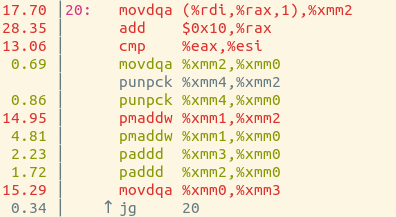
So instead I used perf, which is a totally magical performance measurement tool for Linux. I needed to upgrade my kernel first, which was a bit nervewracking. But I did it! And it was beautiful. There are colours, and we got it to annotate the assembly code with performance statistics. Here’s what I ran to do it:
$ perf record ./bytesum_intrinsics The\ Newsroom\ S01E04.mp4
$ perf annotate --no-source
And here’s the result:
The movdqa instructions have to do with accessing memory, and it spends 32% of its time on those instructions. So I think that means that it spends 32% of its time accessing RAM, and the other 68% of its time doing calculations. Super neat!
Category: Linux
Linux is my primary operating system. I used it on the servers, desktops, laptops, netbooks, and even mobile phones since approximately 1997. I’ve tried a number of distributions over the years, and even created a couple myself. I still look around sometimes to see what others are up to. But most of my machines are running some sort of Red Hat – either a quick and easy Fedora Linux, or a stable and secure Red Hat Enterprise Server, or a cheaper CentOS alternative.
And while by now I am very comfortable in the Linux environment (both graphical and command line), I still discover a lot of new and interesting things about it. When I come across something worthy, I usually share it with the rest of the Open Software world, using this category.
sysdig – system troubleshooting for Linux
sysdig – system troubleshooting for Linux
The Website Is Down
Heartbleed reflections list
Mark McLoughlin has a nice list of thoughts, ideas, and questions to reflect on in regards to the Heartbleed bug.
7 habits of highly successful Unix admins
7 habits of highly successful Unix admins
- Don’t wait for problems to find you
- Know your tools and your systems
- Prioritize, prioritize, prioritize
- Perform post mortems, but don’t get lost in them
- Document your work
- Fix the problem AND explain
- Make time for yourself